Invoice vs Receipt vs Quotation
A practical guide to the differences between a quotation, invoice and receipt for US, UK and Indian businesses, with a comparison table, examples and common mistakes.
By BillGenn Editorial Team Published Last reviewed
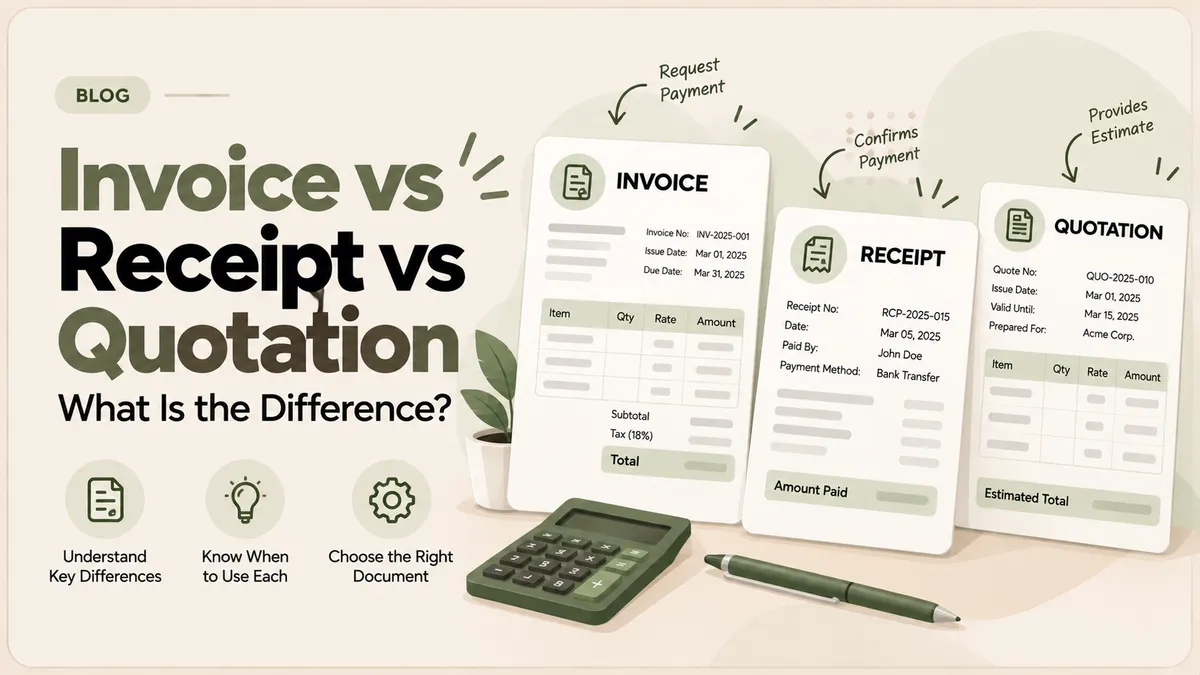
A quotation, an invoice and a receipt look similar at a glance, but they do different jobs. Mixing them up slows US and UK payments, confuses VAT and sales tax records, and can leave an Indian buyer unable to claim input tax credit. This guide explains what each document is, when to issue it and the mistakes to avoid.
The three documents at a glance
| Document | Timing | Main job | Tax treatment | Customer use |
|---|---|---|---|---|
| Quotation | Before the sale | Agree scope, price and validity | Tax shown as an estimate, if at all | Internal approval, budgeting, purchase order |
| Invoice | When payment is due | Request payment for a supply | Tax actually charged is shown | Accounts payable, tax records, payment |
| Receipt | After payment | Prove that payment was received | Confirms the tax amount paid | Proof of purchase, expense claim, refunds |
A simple test: does the document ask for money, or confirm that money arrived? An invoice asks; a receipt confirms. A quotation is neither — it is the offer.
Quotation (quote, estimate, proposal)
A quotation is issued before the sale. It should state:
- What is being supplied.
- Quantity and rate, or a fixed project fee.
- What is excluded.
- Validity, for example “valid for 30 days”.
- Payment terms and any deposit requirement.
- Tax, shown separately if it is known.
A quotation is not a tax invoice. It may show an estimated GST, VAT or sales-tax amount, but it does not trigger a tax liability on its own. If a customer accepts a quotation and asks you to proceed, the next step is normally a purchase order or a signed acceptance, followed by delivery and an invoice.
In the UK, a customer may need an approved quote before raising a purchase order. In the US, a statement of work may reference a fixed fee or an hourly cap. In India, a quotation is commonly used before a GST tax invoice, but the tax invoice is the document that supports the buyer’s credit claim.
What a quotation is not
- It is not proof of delivery.
- It is not a request for payment.
- It is not a substitute for a contract.
- It does not charge tax by itself.
BillGenn currently focuses on invoices rather than a separate quotation tool, but the same line items, quantities and totals apply. See the invoice format guide for a structure you can adapt.
Invoice
An invoice is issued when payment is due — after delivery, at a milestone, or according to the agreed terms. It should include:
- Supplier and customer details, including tax registration numbers where applicable.
- A unique invoice number and date.
- A description, quantity and rate for each line.
- Any discount.
- The tax charged, broken down by the correct head.
- The total and amount in words.
- Payment details and the due date.
The tax treatment depends on the market:
- US — subtotal, sales tax if collected, total (US guide).
- UK — net, VAT, gross for VAT-registered suppliers (UK guide).
- India — a GST tax invoice for a taxable supply, with CGST and SGST or IGST (India guide).
Create a free invoice · US · UK
Receipt
A receipt is issued after payment. It proves that the customer paid and confirms the amount, date and usually the tax included. A retail point-of-sale receipt is a receipt; a B2B email saying “payment received for INV-042” can serve the same purpose.
A receipt is not a substitute for a VAT invoice or a GST tax invoice when the customer needs the document for tax reclaim. If a customer asks for a “receipt” before paying, they usually mean an invoice; ask for clarification rather than sending the wrong document.
Worked example
A UK freelancer agrees a £2,000 project with a marketing agency:
- Quotation:
QUO-2026-0012— £2,000 plus 20% VAT, valid 30 days. - Purchase order: the agency issues a PO referencing the quote.
- Invoice:
INV-2026-0042— £2,000 plus £400 VAT, total £2,400, Net 30. - Receipt: after payment, a short email or PDF confirming £2,400 received against
INV-2026-0042.
The quote and invoice have different numbers because they are different documents. The customer’s accounts team can match the invoice to the PO, and the receipt to the invoice.
Common mistakes
- Sending a quotation with “payment due” on it and treating it as an invoice.
- Reusing a quotation number as the invoice number.
- Sending a receipt instead of a tax invoice for a B2B supply.
- Calling a proforma invoice a final tax invoice when it is not.
- Issuing a bill of supply when a tax invoice is required, or the reverse.
- Changing a sent invoice without a credit note.
A practical decision guide
- Has the customer approved the price? No → quotation.
- Has the work been delivered or the milestone reached? Yes → invoice.
- Has payment arrived? Yes → receipt.
- Does the customer need the document for tax credit? Tax invoice, not a receipt.
Numbering
Use separate series: QUO- for quotations, INV- for invoices, CN- for credit notes. See invoice numbering best practices.
Next step
Send your next bill with BillGenn — PDF in minutes, no subscription. For the document rules, see common invoicing mistakes.
Sources and further reading
Primary or official sources used when checking the factual points in this guide.
Editorial note
This guide is general educational information, not tax, legal or financial advice. Rates, thresholds and document rules can change and depend on your circumstances. Verify the current position with the relevant authority or a qualified professional. Read the editorial policy and disclaimer.
Spotted an error? Email hello@billgenn.com with the page URL and the specific point so it can be reviewed.
Frequently asked questions
Is a receipt the same as an invoice?
No. An invoice requests payment; a receipt proves payment was already received. B2B tax reclaim in the UK usually needs a VAT invoice, not only a receipt.
Do I need a quotation before invoicing?
Not legally, but many US and UK clients require an approved quote or purchase order before accounts payable will pay an invoice.
Which document shows VAT or sales tax?
Quotations may show estimated tax; invoices show the tax actually charged; receipts confirm what was paid, including tax.
Can a receipt replace a VAT invoice for input tax credit?
Usually not. In India, a registered buyer generally needs a tax invoice to claim input tax credit. A receipt or bill of supply is not a substitute for a taxable supply.
What happens if I send a quotation instead of an invoice?
The customer may not be able to match it to a purchase order, process payment or claim tax credit. A quotation is a pre-sale document; the invoice is the billing document.